Be honest, when you first went self-employed, did mortgage applications even cross your mind?
You were probably thinking about invoices, tax returns, building your client base, and whether you'd actually make it work. Then a few years fly by. Now business is thriving. You're earning well. And you're ready to buy a home (or remortgage) across Greater Manchester — Manchester, Wigan, Bolton. The lot.
Then reality hits. Applying for a mortgage when you're self-employed can feel like speaking a different language. Lenders want proof. Mountains of it. Consequently, you can end up buried in paperwork you didn’t even know existed.
Here’s the thing: you shouldn’t pay more or jump through endless hoops just because you work for yourself. If you can prove your income and afford the repayments, you’re just as good a bet as someone on a PAYE salary. You just need to know what lenders want to see.
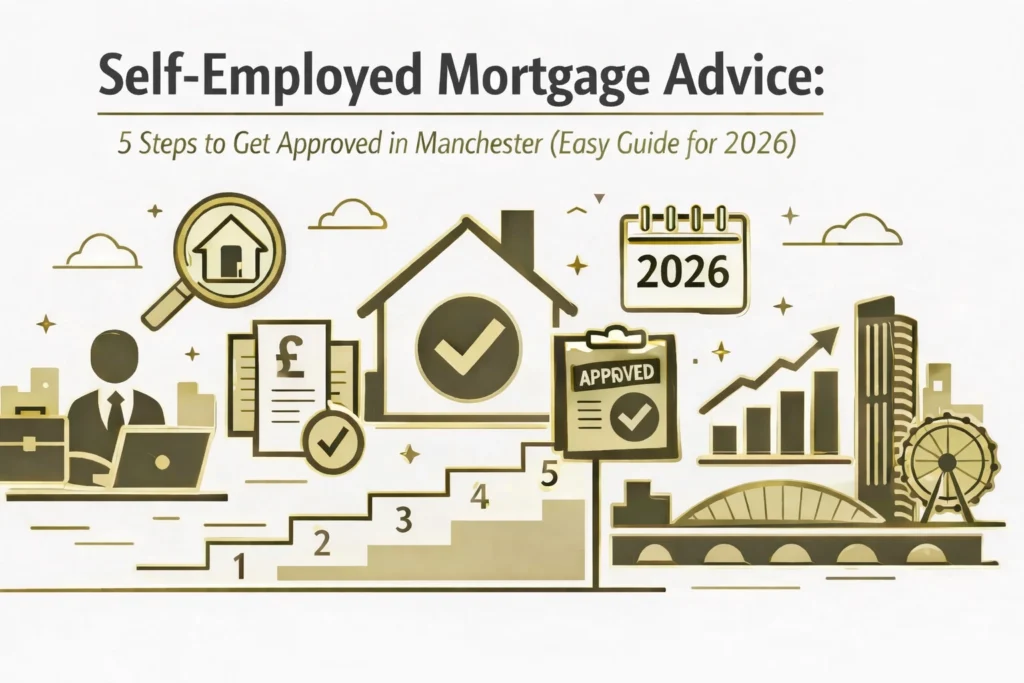
So, let’s break it down into five straightforward steps. You’ll feel mortgage-ready in 2026.

Step 1: Get Two to Three Years of Financial Evidence Together
This is the big one. When you're self-employed, lenders can’t ring your HR department to confirm your salary. Instead, you show them certified proof. They want to see your income is real, steady, and likely to continue.
No matter if you’re in Manchester city centre, working from home in Wigan, or running the show in Bolton, most lenders ask for the same core things:
📄 Two to three years of certified accounts , Your accountant needs to prepare and sign these. If your mate’s cousin “does a bit of bookkeeping”, it won’t cut it.
📄 SA302 forms or Tax Year Overviews , HMRC provides these. They show your income and tax paid for each year. For instance, you can download them via Government Gateway. Or your accountant can grab them.
Why do lenders care so much? Because they want to see you’ve got staying power. If your income jumps from £50k to £18k, lenders start asking questions. Moreover, they love consistency. An upward trend helps even more.
A quick word on company directors: If you run a limited company, lenders usually assess salary plus dividends. Some average your income over two or three years. Others use your latest year if it’s higher. Consequently, the “best lender” can change fast. That’s where chatting with us at Black & Gold Financial Services saves you time. We know lenders across Manchester, Wigan, and Bolton. Furthermore, we know which ones fit your setup.
Step 2: Grab Your ID and Proof of Address
This step stays the same whether you’re self-employed or not. Still, it’s worth ticking off early.
You’ll need:
🪪 Photo ID , A valid passport or UK driving licence.
🏠 Proof of address , A utility bill, council tax statement, or bank statement from the last three months. Make sure the name and address match your mortgage application exactly.
It sounds basic. However, this is where loads of applications get delayed. People move. Documents don’t match. Consequently, the lender asks for more evidence. If you’ve just relocated to Manchester or moved over from Wigan, double-check everything before you submit it.

Step 3: Round Up Your Bank Statements and Deposit Evidence
Lenders want to understand what’s going on in your accounts. That means business and personal.
You’ll typically provide:
💼 Three to six months of business bank statements , These show cash flow in real time. Lenders use them to check your income matches your accounts.
💳 Three to six months of personal bank statements , These show how you actually live. Are you within your means? Do regular outgoings affect affordability? Are you managing money sensibly?
Lenders also scan for red flags. For instance: gambling, missed direct debits, or constant overdraft use. If your account looks a bit chaotic, tidy it up before you apply (and yes, lenders do notice that cheeky Deliveroo habit).
💸 Deposit evidence : You must show where your deposit comes from. Savings? Great. Gift from family? You’ll need a letter confirming it’s a gift, not a loan. Selling another property? Show the completion statement.
Lenders stay strict here because of anti-money laundering rules. It’s not personal. It’s the law.
Step 4: Save a Decent Deposit
Let's talk numbers.
Most lenders want at least a 10% deposit if you're self-employed. Some will go as low as 5%. However, you’ll need spotless accounts and strong affordability. The bigger your deposit, the better your approval odds. Moreover, you’ll usually get a better rate too.
If you’re buying in Manchester, Wigan, or Bolton, prices vary wildly. A city-centre flat costs very different money to a semi in Wigan. And a family home in Sale is different again. So, do your research. Work out what’s realistic for your budget.
A bigger deposit also shows commitment. Consequently, it lowers the lender’s risk. That can make lending to you an easier “yes”.
Can’t stretch to 10% yet? That’s okay. Give us a shout! Some lenders consider lower deposits. Furthermore, we’ll tell you exactly what paperwork you’ll need.
Step 5: Get an Agreement in Principle
Before you start house-hunting (or getting serious about remortgaging), get yourself an Agreement in Principle (AiP).
This is a quick, soft-check from a lender. It tells you how much they’ll likely lend, based on your income and circumstances. Best bit? We handle the AiP for you as part of our service. Consequently, you don’t sit there second-guessing forms or wondering if you clicked the right thing.
Why bother?
✅ It shows sellers you're serious : In a competitive market like Greater Manchester, an AiP strengthens your offer. That includes Manchester, Wigan, and Bolton.
✅ It gives you a realistic budget : Don’t fall for a £350k house if the lender only offers £280k. Painful.
✅ It speeds up the full application : You’ve already done some groundwork. Moreover, the formal process can move faster.
One thing to note: an AiP isn’t a guaranteed mortgage offer. Lenders still run full affordability checks later. They also check your credit. However, it’s a brilliant starting point.

Why Self-Employed Mortgage Advice Matters Across Greater Manchester
Greater Manchester’s property market is buzzing. If you’re a freelance designer in the Northern Quarter, a contractor across Salford, or a tradesperson in Wigan, you’re not alone. Loads of self-employed buyers are making moves.
But here’s the reality: lenders don’t all treat self-employed applications the same. Some are brilliant. Others are… not. Some average your income over three years. That can sting after a slower year. Others use your most recent year if it’s strongest. Consequently, picking the right lender matters.
That’s where a mortgage broker across the North West makes a real difference. We know which lenders welcome self-employed income. Moreover, we know how to present your accounts properly. We also do the legwork. So you don’t have to.
At Black & Gold Financial Services, we’ve helped dozens of self-employed clients across Greater Manchester — including Manchester, Wigan, and Bolton. Furthermore, we help you do it without overpaying or jumping through unnecessary hoops.
Ready to Take the Next Step?
If you’re self-employed and thinking about buying or remortgaging in 2026, now is a great time to get organised.
First, gather your accounts, tax returns, and bank statements. Next, check your deposit is ready to go. Finally, if you’re unsure where you stand, give us a shout. We’ll point you at lenders that fit.
We’ll walk you through the process. We’ll answer your questions in plain English. And we’ll find a mortgage that fits your life.
Call us on 0161 250 1470 or visit blackandgoldfinancialservices.co.uk to get started. Let’s make 2026 the year you get the keys.
Your Home (or property) may be repossessed if you do not keep up repayments on your mortgage or any other debts secured on it. There may be a fee for mortgage advice, the exact amount will be based on your circumstances.